Driving in France sounds much more intimidating before you’ve done it. In reality, we’ve always found the French part of the journey to Disneyland Paris remarkably straightforward.
We’ve always carried the things we’re supposed to carry, prepared the car properly and checked the rules before leaving home.
We’ve just never actually needed any of it.
That doesn’t mean we’d skip the preparation. It simply means the reality of driving in France has always been much less dramatic than the checklist makes it sound.
Before you leave
Sort the paperwork, headlights and speedometer at home, download your route offline and keep anything you may need in an emergency somewhere you can actually reach it.
Before you leave
- Valid UK driving licence
- V5C log book
- Insurance details
- Valid MOT and vehicle tax
- UK identifier if needed
- High-visibility vest
- Warning triangle
- Headlights adjusted or beam converters fitted if required
- Breakdown cover that includes France
- Crit’Air sticker if our journey requires one
- Speedometer ready to display km/h
- Offline maps downloaded
We’d also check the official guidance again shortly before travelling. Rules can change, particularly around low-emission zones, and we’d rather spend five minutes checking at home than discover something halfway through France.
The paperwork is simpler than it sounds
Most UK visitors with a valid photocard driving licence don’t need an International Driving Permit for a normal holiday in France.
We take our driving licences, V5C and insurance details with us. If you’re travelling in a leased or hired vehicle, check what documentation the provider requires before taking it abroad.
A green card isn’t normally required for a UK-insured vehicle travelling in France, but we’d still check that our own insurance provides the cover we expect while abroad.
Your car also needs the correct UK vehicle identifier. Depending on what’s already displayed on your number plate, that may mean adding a separate UK sticker.
Sort the car before you travel
This sounds ridiculously obvious once you’ve done it, but we’d definitely sort the speedometer on the driveway.
French speed limits are shown in kilometres per hour. Many modern cars let you change the digital speed display from mph to km/h through the dashboard settings, so work out how yours does it before you leave.
You don’t want to be sitting outside the Channel terminal going through menus trying to find the setting while everybody else disappears towards Calais.
We’d do the same with the headlights. Some modern cars have a European driving setting, while others may require beam converters. Know what your own car needs before the trip.
Driving on the right
This was the bit we worried about most before our first journey.
It becomes normal surprisingly quickly.
Once we’re on the autoroute, it doesn’t feel particularly different from motorway driving at home. You’re following clearly marked lanes and travelling with the flow of traffic.
The moments when we’re actually more conscious of driving on the right are after we’ve stopped. Leaving a petrol station, pulling away from a service area or joining a quiet road is when UK muscle memory can briefly kick in.
Our simple reminder is:
Driver towards the middle. Passenger towards the kerb.
Speed limits in France
French speed limits are in kilometres per hour. Always follow the signs, because local limits can be lower.
130 km/h
110 km/h
80 km/h
50 km/h
One important difference for UK drivers is wet weather. When it rains, the motorway maximum normally drops from 130 km/h to 110 km/h.
That’s an easy one to forget when you’re used to UK speed limits staying the same when it rains.
French motorway tolls
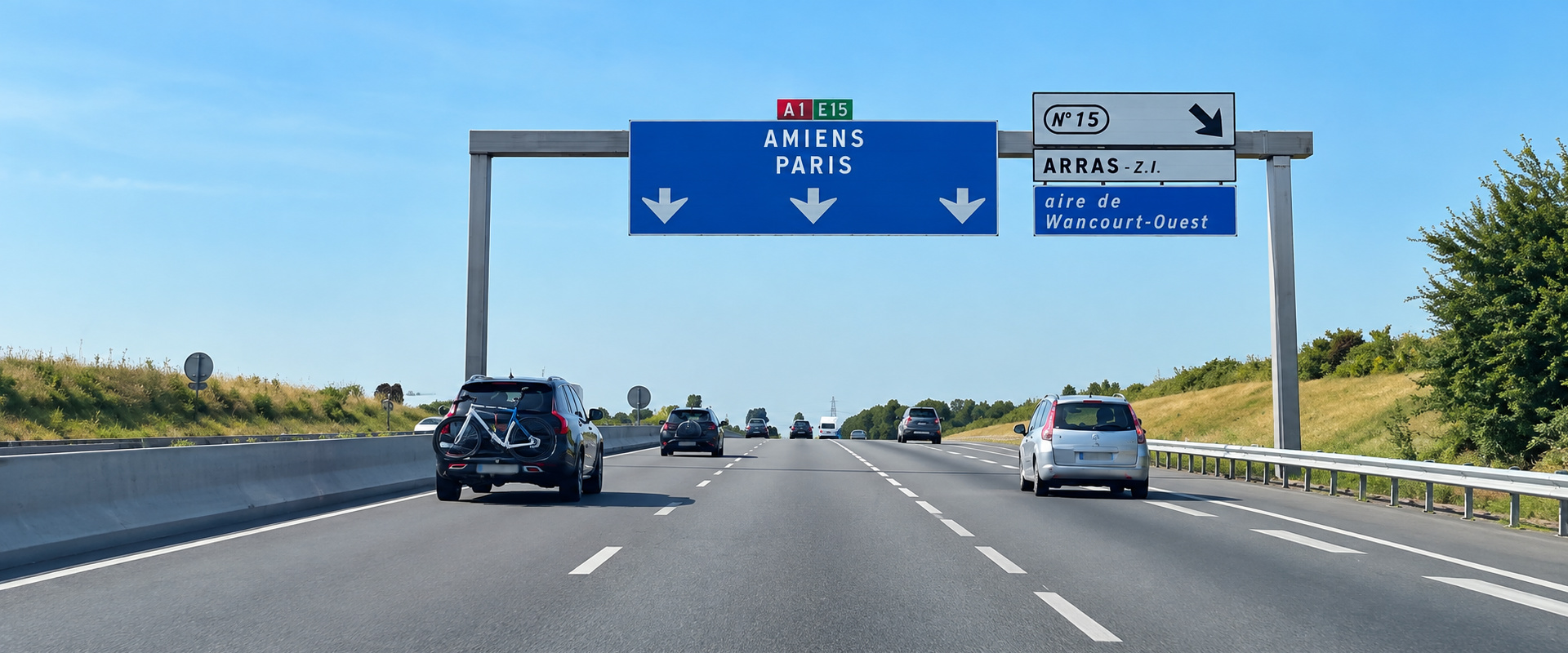
If you’re driving from Calais towards Disneyland Paris, you’ll probably use French motorway tolls. You’ll see these referred to as péages.
Before our first trip they sounded far more complicated than they actually are.
You may take a ticket as you enter a toll section and pay when you leave, or simply reach a payment point and pay the displayed amount. Cards are widely accepted.
The main complication in a UK car is that the machine is designed for somebody sitting on the left.
So the passenger gets a job.
They’re now responsible for toll tickets, payment and looking suitably pleased with their new position of authority.
Some French motorways also use barrier-free tolling, so we’d pay attention to signs along the route rather than assuming every toll will involve a booth.
Do you need a Crit’Air sticker?
Crit’Air is France’s vehicle emissions classification system. The sticker is required in certain low-emission zones and can also be relevant when temporary pollution restrictions are introduced.
For a Disney road trip
You don’t need a Crit’Air sticker simply because you’ve driven into France. Check the route you actually plan to use.
If you’re planning to drive into Paris or another low-emission zone, check the current rules for your exact vehicle before travelling.
If you do need one, order it through the official French Crit’Air website rather than one of the third-party services charging considerably more to do the same thing.
Download your route before you leave
We’d always download the relevant map area to our phone before travelling.
Mobile coverage is generally good and we’ve never had a major issue with navigation, but there’s no reason to make the journey completely dependent on mobile data.
Signal can disappear. Roaming can misbehave. Phones can decide that the exact moment you’re approaching an unfamiliar junction is apparently the perfect time to stop loading anything.
Download the route while you’re at home. We also save our hotel address somewhere offline.
Small bit of preparation. Potentially very useful.
Fuel and motorway services
One of the things we really like about driving in France is how easy it is to stop.
You’ll regularly see signs for aires. Some are basic rest areas with toilets and picnic facilities, while others are proper motorway services with fuel, food, shops and coffee.
We’ve never felt as though we have to keep going because there won’t be anywhere else to stop. If somebody needs the toilet, we stop. If we fancy a coffee, we stop.
Motorway fuel can be more expensive, so we sometimes fill up away from the autoroute if it fits naturally with the journey. Just make sure you know what fuel your own car needs rather than trying to work it out for the first time while staring at a French pump.
What we actually find different
Very little.
That’s probably the most reassuring thing we can say.
We prepare everything before leaving the UK. We carry the correct equipment. We sort the headlights and speedometer. We download the route.
And then we drive.
Once we’re settled onto the motorway, it feels remarkably normal. The roads are good, places to stop are regular and we’ve often found the French section considerably more relaxing than getting across the UK to the Channel.
Our tips
Sort the car at home. Work out the headlights and km/h display before travelling.
Download offline maps. Don’t make yourself completely dependent on mobile signal.
Keep the high-vis vest accessible. Not underneath your luggage.
Remember the wet-weather speed limits.
Let the passenger handle the tolls. It’s much easier in a right-hand-drive car.
Check whether your actual route needs Crit’Air. Don’t assume either way.
Take the first few miles slowly. Driving on the right starts feeling normal much quicker than we expected.
The Coffee & Magic verdict
Before our first trip, driving in France was one of the things we were most nervous about.
Now it’s one of the things we think about least.
We’ve always prepared properly, carried what we’re meant to carry and checked the current rules before travelling.
We’ve just never needed any of it.
Once we’re across the Channel and settled onto the motorway, the journey towards Disneyland Paris is usually straightforward, calm and much easier than we imagined the first time.
Do the preparation at home, then enjoy the drive.